RV-10 Nav-Com Upgrade

The Apollo and latterly Garmin SL-30 was and indeed is a great bit of kit, providing Nav and Com functions in a pleasingly small package. But for those who fly in Europe, its lacking one important thing – 8.33 capability on the Com side.

Many owners have continued to use their existing SL-30s as a back-up radio, suitably placarded to show non-compliance with 8.33 requirements. And the reason why is usually not hard to fathom. The small size of the Sl-30, so much a blessing when originally installed turns out to be a curse when it comes to replacement. All the available 8.33 complaint boxes are bigger. And if you have. tight stack, that’s a problem!

We were asked to look swapping an Sl-30 in and RV-10 for a Garmin GNC-255. The new Garmin is just four-tenths of an inch taller than the SL-30 but when there is little or no space, that’s a big problem.

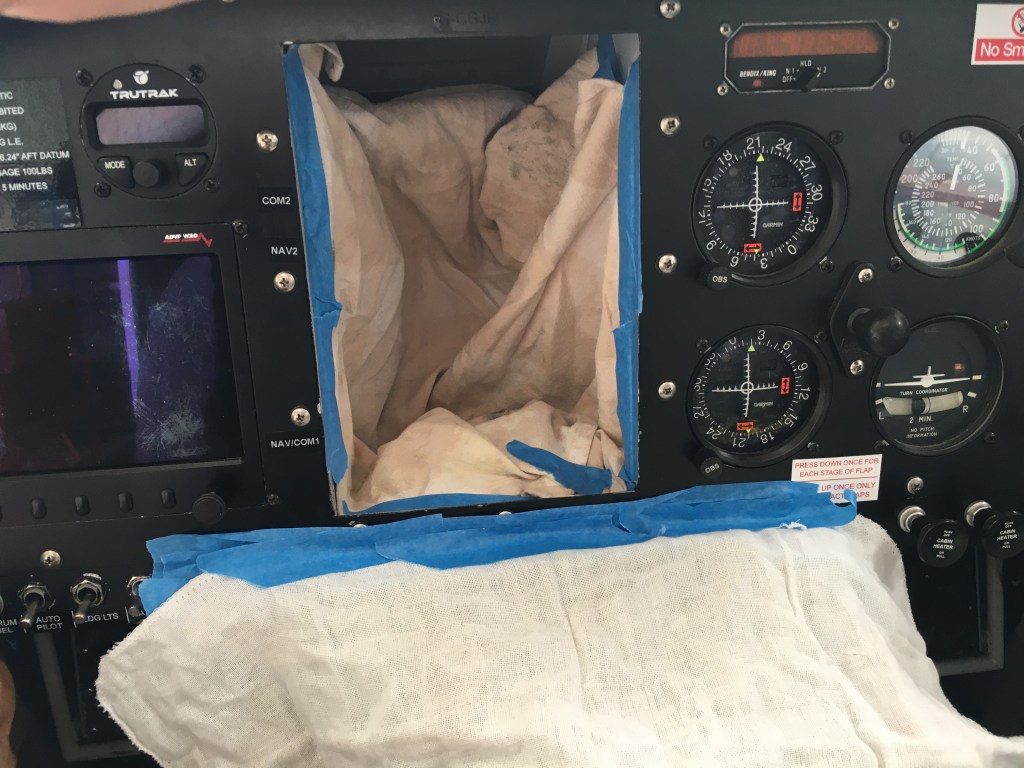
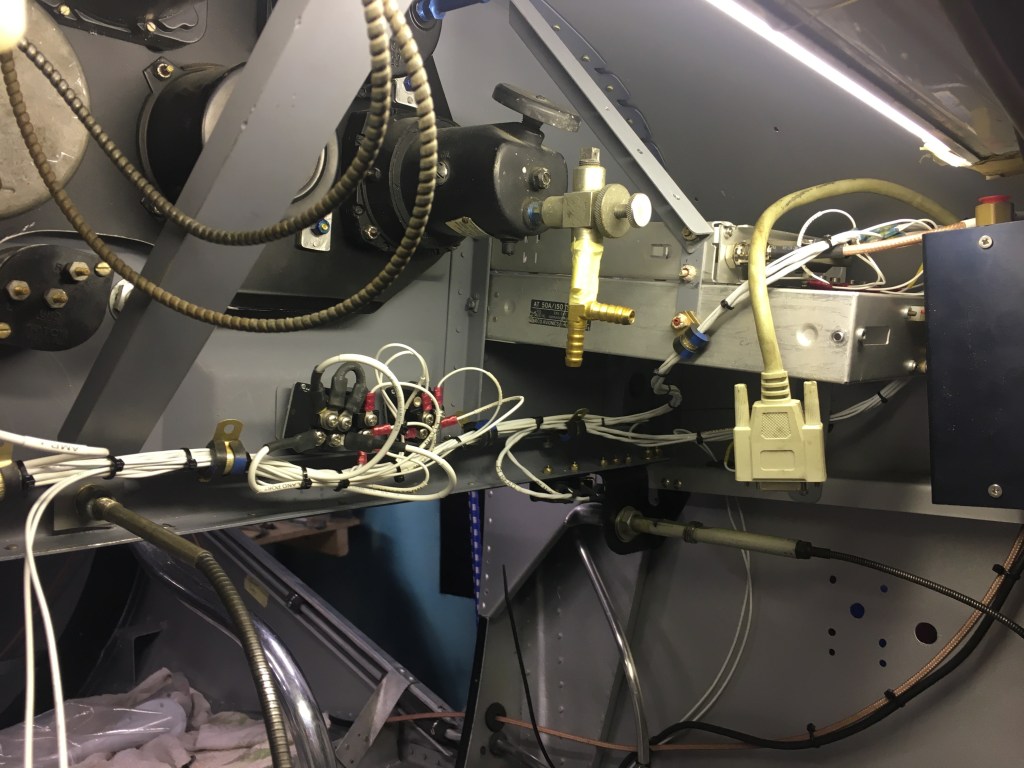
Close inspection of the existing stack indicated that there might be perhaps two-tenths of an inch to be had by moving everything down. At the top, there was space for a two-tenths cut-out in the panel, but what about clearance on the back of the avionics under the glare shield? Trickier… The only way to find out was to pull the existing kit out. With some careful rearrangement and cutting away of a small non-structural support behind the instrument panel it appeared to be just be possible to ease the audio panel into the top slot in the stack.

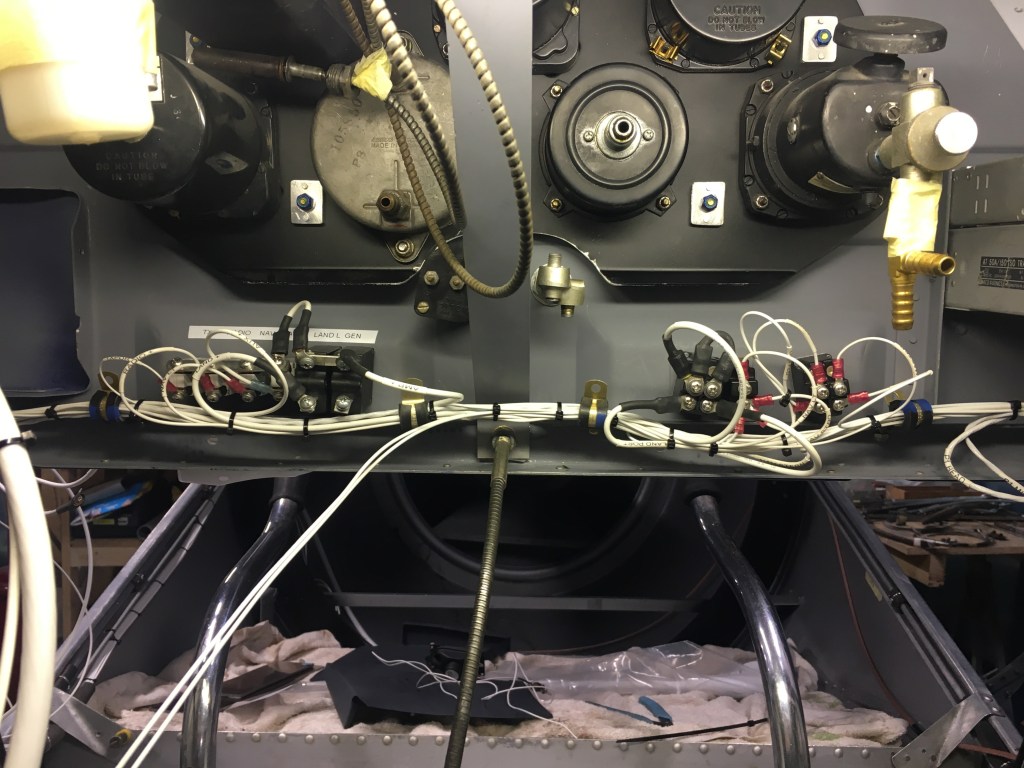
The original wiring was to say the last ‘tight’. Without service loops, it was impossible to draw the connectors out of the panel and the prospect of re-pinning them in situ was not not an attractive one.

The owner had also asked if it was possible to couple the GNS 530 to an existing autopilot. Time taken thinking is time saved grafting so the fist task is to work out what needs to connect to what. The Garmin GNS530 has some interesting undocumented features regarding the ability to (not) output Aviation Format data on more than one port. This requires a ‘fix’ in the form of spliced connections. Time for a diagram.
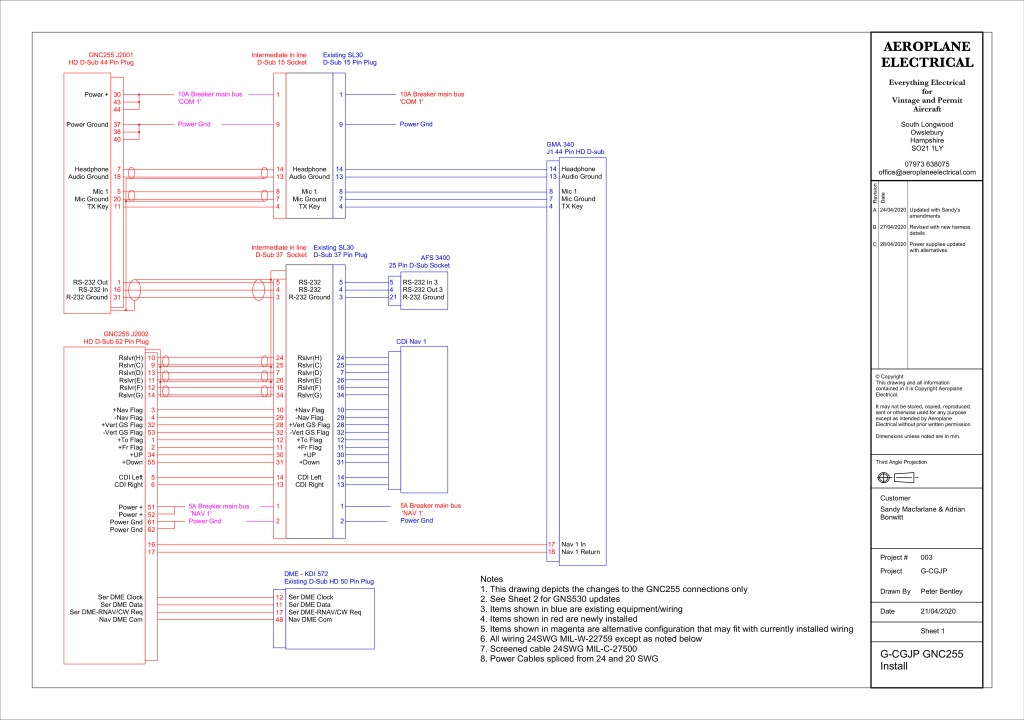
The owner had also asked if it was possible to couple the GNS 530 to an existing autopilot. Time taken thinking is time saved grafting so the fist task is to work out what needs to connect to what. The Garmin GNS530 has some interesting undocumented features regarding the ability to (not) output Aviation Format data on more than one port. This requires a ‘fix’ in the form of spliced connections

Taking great care to mask-up and protect the existing panel, it was then out with the metalwork tools and set to work to enlarge the panel aperture. remove and refit the instrument support rails and make new rear supports. Unlike to previous installer, we opted to fit captive nuts all around. The time taken in fitting these is saved many times over in the installation process alone and the ease of future maintenance assured.
Given the difficulty in working on the installed wiring, we elected to make a patch-harness to going the old SL-30 wiring to the new GNC255, with the addition of a couple of extra cables to facilitate a direct feed of Nav data to the installed autopilot. If nothing else it can all be tested on the bench prior to installation

Given the tightness of the installation it proved quite tricky to assemble the various boxes in the panel and connect all the connectors. You have got to hope it all works correctly when you switch it on as the prospect of taking it all apart again to correct one bad wire is not a very attractive one.

Sure enough, it all worked first time….
Why Rewire

Many of the aircraft we see were built in the 1940s and have been refitted, modified and amended many times over the years. It surprises me how often much if not all the original wiring remains. And much of it is in poor or very poor condition.

The original wire from the 1940 and 50s was neither as tough nor as fire resistant as modern material and unlike new cable, the insulation will give off hazardous fumes when burned. All things taken together, the case for renewal is often overwhelming.

Whilst some owners choose to complete the wiring upgrade at the same time as an avionics refit, change to 8.33 radios or the installation of Mode-S or ADS-B, some simply wish to retain their existing kit but reliability and safety by simply updating the wiring.

Over time, we have settled on a robust approach and have become increasingly reluctant to reuse parts of old systems. The temptation to reuse old switches, circuit breakers and the like to save a few pounds is obvious, but like the wiring, many of these old components were made to historic standards and some have also simply won-out. From a cost perspective the time and effort in tracking down a post-rewire fault die to an old reused component is often many multiples of the cost of simply replacing that component in the fist place. If in doubt, chuck it out…

One of our recent projects involved rewiring a 1947 Luscombe which had come in for something short of a rebuild but more than just regular maintenance. The project is ongoing but a few photos speak louder than a thousand words…

Lovely modern wiring all neatly labelled, tied and clipped in place. More work to do yet with pitot-static plumbing and final wiring.

Original instruments retained, refurbished where necessary. All new wiring and switches.

This is typical of what comes out… Scrap metal. It’s often surprising how much weight is saved..

Antenna Troubles

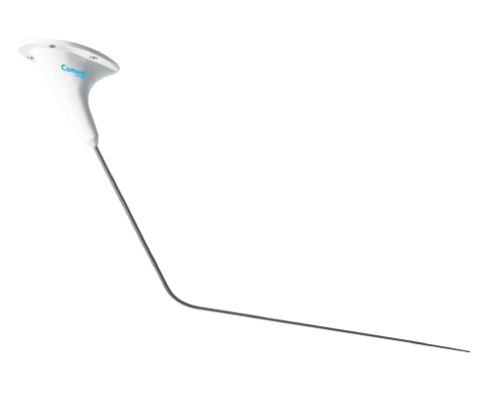
Comant Cl222-1 FM radio antenna. Frequency range 88-108MHz As fitted originally.

I was approached by the owners of an RV-10 who were having problems with their COM 1. In simple terms, the receive performance was poor and the transmit performance was diabolical. There were all kinds of theories; antenna splitters, poor coax cable, defective connections, you name it. How long had the problem persisted? Well they said, at least as long as we have owned the aircraft. COM 2 works fine so we don’t worry too much.

So, the first thing to do was connect up the VSWR meter and see what was happening in the feed line. Answer, not much. The VSWR reading was off the scale on my meter. Not good. So I pulled out the feed line and replaced it with a test-item of known quality direct from the radio to the antenna. No change… I’m thinking it must be the antenna… But it looks fine. Let’s look in the manufacturer’s catalogue to see what they say… Very strange, the antenna looks almost like the one I’m thinking it is, but just not quite.

To cut a long story short, at some point, probably from new, the aeroplane had been fitted with an FM broadcast receive antenna rather than a COM antenna. Sure, they look almost identical but the performance is very different.

A new antenna of the correct specification was ordered, fitted and hey presto, five by five at forty miles.

Simple but not so simple…

Comant CI 292-1 antenna for VHF coms. Frequency range 118-137MHz. After refit. 

Welcome to Aeroplane Electrical

No matter how dark the clouds the sun always reappears eventually. I’m writing this in the midst of Coronavirus lockdown with all flying suspended and my workshop far away. But it will end, the world will return to some new normal and those of us who love aviation and our aeroplanes will return to the skies.

Aeroplane Electrical will be here for you.